©
Е.М. Trunaev
Part 1
The new concept of formation and development
of the Solar system.
Astronomic
observations testify that our galaxy can be classified as a multi-sleeved spiral structure
and that the form of a sleeve, near the Sun, follows the line of a logarithmic spiral.
Thus,
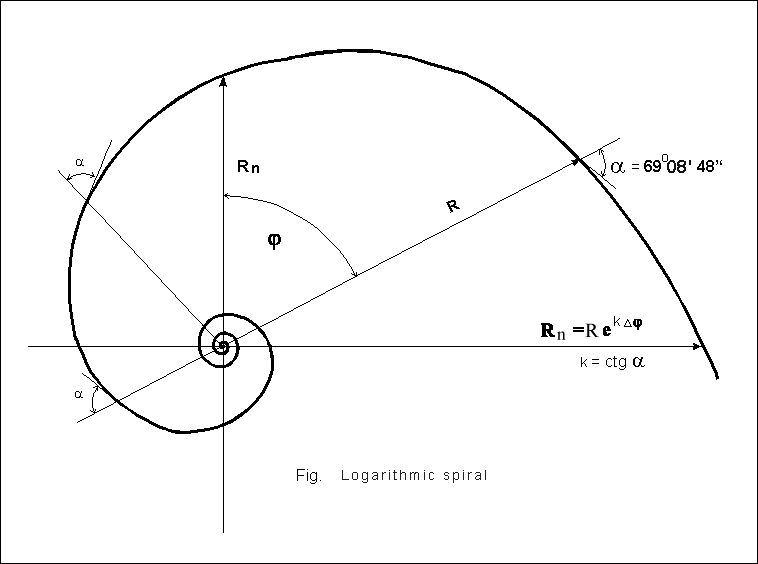
Rn = R e k Dj,
has a angle of a "whirl" a = 70 °
(the angle between the radius-vector and the
tangent line to any of the spiral points), k - is the cotangent to angle a = 70 ° , R
is a certain arbitrary chosen radius, е - is the base of natural logarithms, and j - is the angle (radius) between Rn and R. [fig
].
This new
concept of cosmogony is based on two given conditions: unity of reason and unity in the
nature of physical processes which determine the development of the galaxy and all of its
affiliated elements: stars, solar systems, and satellites about the planets. Essentially,
all of these objects represent a uniform hierarchical sequence. That is why uniform
physical laws determine the general development of the above structures. The principle of
transference and exchange of energy between the specified objects occurs from main
(parent) structures to structures of higher order (affiliated). Thus, the initial pulse of
the rotation of a protosolar cloud of the solar system was determined as a result of the
diversion of a part of the moment of the rotational pulse of the Galaxy.
As
hydrogen is the most common chemical element in nature, it serves as the material basis
for the formation of all star-planet systems. Modern science makes a distinction between
the chemical structures of celestial bodies' environments due to a degree of processing of
this initial substance. Hydrogen is transformed and more complex chemical elements are
synthesized from it, spontaneously formed within the core of spherical celestial objects.
The general sequence in the development and transformation of hydrogen, as well as the
mechanisms by which other chemical elements are formed, is uniform for all of the
celestial objects specified above. The creation and maintenance of special conditions
supporting the development of nuclear synthesizing reactions typically characterize the
normal evolution of stars, planets and their satellites. Most important is the tendency
toward self-organization of masses, developing sequentially, transforming from shapeless
clouds of gas to vortex units of various sizes, having precise spiral structures and
hierarchical co-subordination.
With reference to the Solar System, this means that the Sun, planets and their spherical
satellites were formed in a joint and uniform vortex process.
A gaseous cloud of hydrogen was on the periphery of one of the spiral sleeves of the
Galaxy. Separate particles of gas moved chaotically, whereas the whole cloud, together
with the other objects, participated in a common galactic rotation in relation to the
center of masses and the center of rotation of the whole Galaxy. Meanwhile, the masses'
"own" center was gradually designated in the cloud, creating the masses'
"own" gravitational field. Under the influence of the central directed force of
gravitation, the transitional motion of particles in the gaseous cloud was transformed
into a circular one, which was uniformly accelerated. Disparate forces work as if in
unison to form a vortex centripetal motion in the cloud: the forces acting tangentially to
one another, connected by their "own" -- and a common -- galactic rotation, and
radial forces having their "own" gravitational field. Gradually, a uniform
spiral vortex structure appears from a shapeless cloud of gas, (the macro-Vortex of the
Solar system). It has the shape of a very thin extended disk, consisting of two
different-sized spiral sleeves, rotating synchronously in the same plane. In each sleeve,
matter moves from the periphery to the center of the system, thus, increasing
concentration of particles in the Vortex’s center. The basic parameters of the Vortex
were determined by the angle of "whirl" of its spiral sleeves. Analysis of data
reveals that our system’s pre-solar Vortex had an angle of "whirl" of a= 69° 08 "48", which closely conforms to the common galactic angle of a - 70°. All this enables us to present the Vortex graphically and
to scale [ fig. 1].
As the
particles moved toward the center of the Vortex, their orbital movement accelerated,
according to the law of preservation of moment of the movement’s pulse, and increased in
accordance with the formulas:
v = d e - k Dj / 2 .
The speed increased about one order of
magnitude for each two coils of a spiral sleeve the particles passed. The centrifugal
forces, in opposition to the force of gravity (Fcf = m v2/ R), also increased, proportionate to the increased rotation speed. This means that with the appearance of the
centrifugal forces, the action of gravitational force was reduced. This mainly affected
the particles appearing in the planes of rotation of the newborn Vortex. Radial movement
(toward the center) experienced reduced speed, whereas, for particles driven in a
near-normal direction (relative to the plane of the system’s rotation), a reduction in
“radial” speed was not observed.These latter particles reached the central part of the
cloud faster than the others did. They seemed to be "poured" there, from above
and below. This is the root cause of the process of "flatness" and gradual
structurization out of an earlier shapeless mass of gas. At the same time, the
acceleration in the orbital motion of particles (v) in the cloud and the growth of
centrifugal forces do not correspond to the character of change of the gravitational
forces
(F= gmM /R2).
In the finishing stage of development of the
Vortex, the growth of centrifugal forces in some parts of the Vortex begins to prevail
over the growth of gravitational force. This causes destabilization in the vortex's
structure; rifts appear and the continuity of the sleeves is compromised. The first break
then resulted, about 108 million km. from the Vortex’s center (Venus’ orbit
approximately). This event then repeated itself
a little bit further from the center of the Vortex, and indeed continued regularly,
at first in angular intervals of p/4, thereafter p/2 [see
the table 1]. As a result, the Vortex's central part was created first, followed by a second
and third generation system of “micro”-vortexes at well-defined distances from the
center. The core of the modern Sun was formed from the central part of the Vortex, and,
accordingly, the cores of the modern planets and their spherical satellites were formed
from the vortexes of the 2nd and 3rd orders. Such separation of the Vortex allows us to
understand the essence of the underlying causes of the law of increase in orbit radii of
the modern planets, traditionally called the Titius-Bode rule.
The parameters of orbits (except
for Pluto) can be calculated more precisely and reliably than by the specified
"rule" with the formula
Rn = R e k Dj;
where Rn
is the perihelion of nth planet, k - the cotangent of the angle - 69° 08 "48", Dj = p/4 for the inner planets, and p/2 - for the outer planets. Approximately:
Rn inn = R (n-х) * 1,8191x/2;
and
Rn out = R (n-х) * 1,8191x
[fig. 1.] You can read some very ineresting
results in part 4. Besides this new approach to the pre-solar
system as a system of the destroyed vortex structure, we can understand now a number of
other peculiarities of the Solar system’s structure. In particular, as all planets in
the Solar system inherit peculiarities of the pre-Vortex motion of matter, their orbits
move in the same direction and approximately in the same plane. This plane coincides with
that of the Sun's equator. The same law determines the motion of the spherical satellites
of the planet giants, as well as the character of rotation of fragments in the so-called
asteroid belt. These fragments were formed as the result of the impact and destruction of
two large celestial objects of spherical form -- the planet Phaeton and planet X, which
were once in the uniform system of the planets [ fig.2 ].
The second
and the third parts will consider why modern celestial bodies have distinct chemical
structures and matter in their environments is modular in nature and, among other things,
provide information on the nature of magnetic fields of celestial bodies.
|